


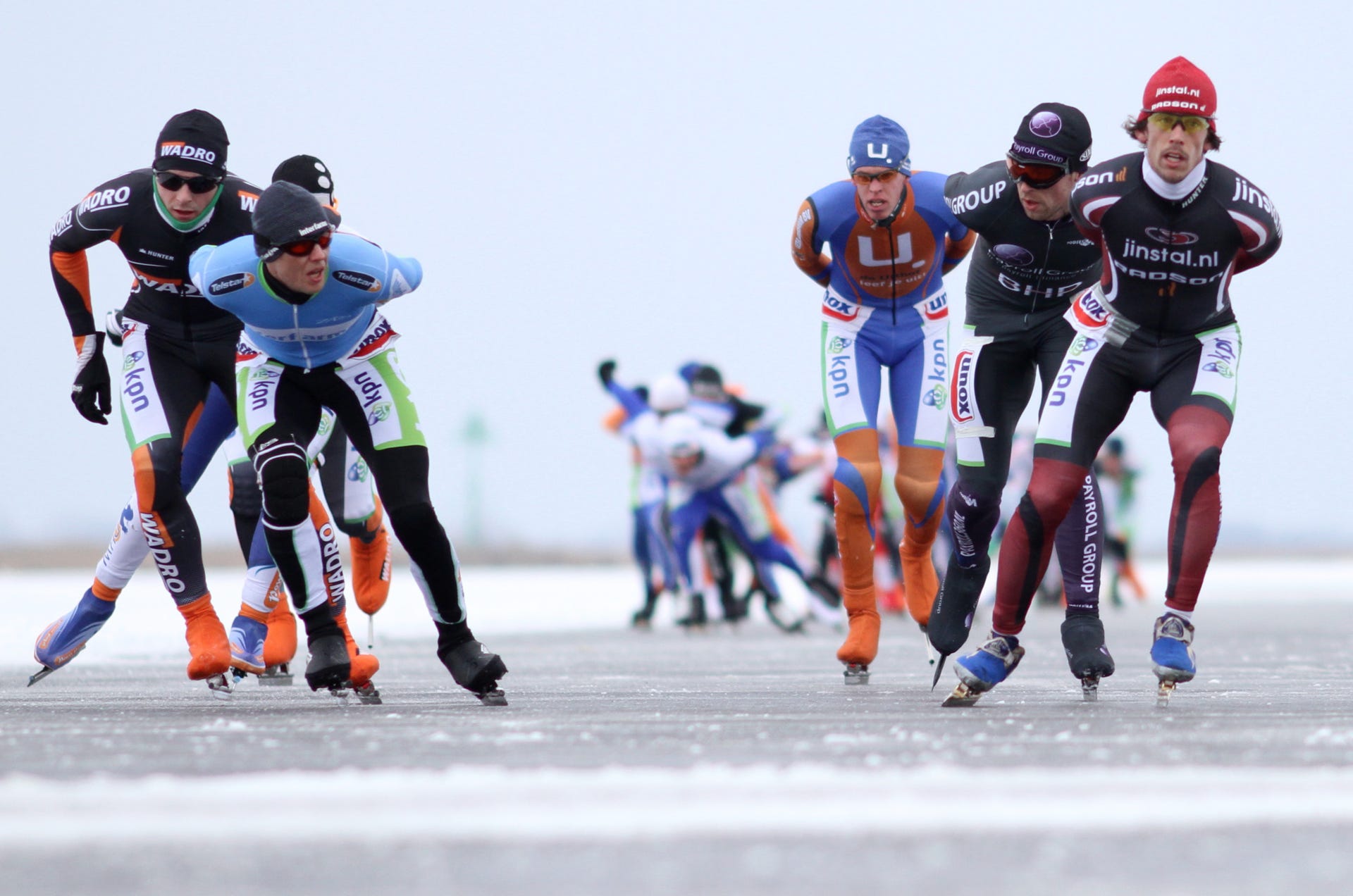

The first speed skating marathon on natural ice this season will take place Friday evening in Winterswijk, after organisers confirmed late Thursday that the ice was thick enough to race. The eastern Dutch town once again claims the honour of hosting the season's first natural-ice marathon, repeating its achievement from last year.
Ice conditions perfect for racing
"The ice surface is thick enough everywhere, varying from 3.2 to 3.7 centimetres," said Geert-Jan Muskens, the Dutch skating union KNSB's national natural ice coordinator. "We need a minimum of 3 centimetres for a competition, so this is more than sufficient. We expect the thickness Friday morning will exceed 4 centimetres. It's a beautiful sheet of ice lying here, with good boarding around the track."
The women will start at 6:00 p.m., followed by the men at 7:30 p.m., according to the Winterswijk Ice Association (WIJV). The confirmation came earlier than expected, the KNSB had indicated there was a strong chance of a natural-ice marathon this weekend but warned that conditions remained uncertain and that Saturday seemed more likely.
Weather window closes soon
The weather is expected to remain cold Friday morning, with temperatures rising slightly above freezing in the afternoon before dipping back below zero for the evening races. This creates a brief but perfect window for the marathon, as warmer weather is forecast to return soon.
According to weather forecasters, warmer air will move into the Netherlands over the weekend, and cloud cover will prevent temperatures from dropping below zero in the coming nights. This means Friday's race may be the only natural-ice marathon opportunity for several weeks unless another cold snap develops.
Competition among ice clubs
Several ice clubs across the Netherlands were competing for the honor of hosting the first marathon. Burgum in Friesland and Haaksbergen in Overijssel were also in the race, but their ice hadn't reached the required 3-centimetre thickness by Thursday. The competition for hosting the first natural-ice marathon between northern and eastern communities is intense, with clubs monitoring weather forecasts obsessively and working through the night when conditions allow.
Winterswijk also hosted the first natural-ice marathon last season in early January 2024, making this back-to-back wins for the eastern town near the German border. The achievement reflects both favourable local weather conditions and the dedication of volunteers who work tirelessly to prepare the ice.
How natural ice is made
Creating natural ice for marathon skating requires more than just cold weather. Ice clubs like Winterswijk's use a sophisticated process that involves spraying water on concrete tracks during frost periods to build up ice layers gradually.
"The preparation process is always unpredictable," explained Henk Te Selle, Winterswijk's ice technician, in a recent interview. "Success depends entirely on weather conditions. With the volunteers, we give it our all every evening when there's an opportunity to make ice."
Clear skies are crucial: cloud cover prevents ice formation even when temperatures drop below freezing. Ice masters must make quick decisions about when to start spraying water, sometimes working through the night to take advantage of brief windows of perfect conditions.
For recreational skating, ice needs to be 5-10 millimetres thick. For a marathon, the minimum requirement is 30 millimetres (3 centimetres), and race organisers prefer even thicker ice for safety and better skating conditions.
Skating fever across the Netherlands
While Winterswijk prepares for its marathon, keen skaters have been out in force elsewhere in the country after several days of frost. Several artificial outdoor rinks have opened, and the Dutch are enthusiastically taking advantage of the cold spell to indulge their national passion for skating.
The Netherlands has approximately 200 ice clubs that go all out to create outdoor rinks, often by spraying concrete tracks with water, when a spell of frost is predicted. The clubs rely entirely on volunteers who monitor weather conditions around the clock and work in shifts to create and maintain the ice.
A Dutch winter tradition
Natural-ice marathons hold a special place in Dutch culture. While artificial ice rinks allow year-round skating indoors, racing on natural ice outdoors carries deep cultural significance. It connects modern skaters to centuries of Dutch skating tradition, when frozen canals and lakes served as winter highways.
The most famous natural-ice skating event remains the Elfstedentocht (Eleven Cities Tour), a legendary 200-kilometre race through Friesland that was last held on January 4, 1997. Climate change has made such extended cold periods increasingly rare, making each natural-ice skating opportunity more precious.
Recent history of first marathons shows how variable winter conditions have become:
December 26, 2021: Noordlaren
December 14, 2022: Burgum
January 2024: Winterswijk
December 27, 2025: Winterswijk
Friday's race represents not just athletic competition but the continuation of a cherished national tradition that depends entirely on weather cooperating for brief windows each winter.