


See more of Dutch Brief in your Google search results
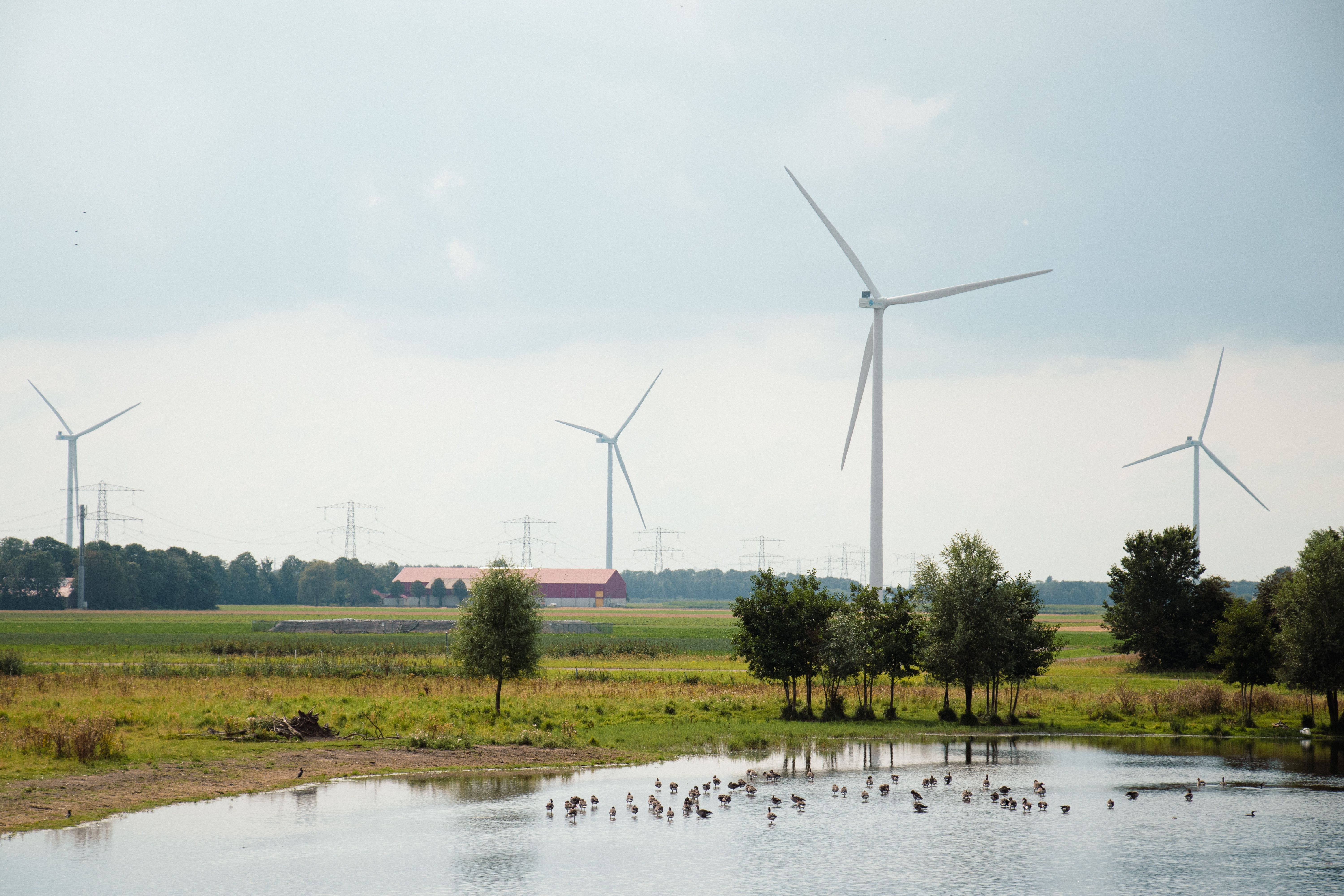
The Netherlands is to get a new nationwide rule setting how far wind turbines must stand from people’s homes. Under a proposal from the cabinet, a turbine will have to be at least twice its “tip height” from the nearest house, meaning a 200-metre-tall turbine would need to keep at least 400 metres away.
How the rule works
The measure is what is known in Dutch as an afstandsnorm, a distance norm. Rather than fixing a set number of metres, the cabinet has tied the required distance to the height of the turbine itself. The reference point is the tip height (tiphoogte), the highest point a blade reaches as it turns, measured from the ground.
The logic of linking the two is that turbines keep getting bigger as the technology advances. A fixed distance in metres would quickly be outgrown, whereas a rule of “twice the tip height” scales automatically: the taller the turbine, the further it must stand from homes. A modern onshore turbine can already reach 200 metres or more, which under the new rule would mean a minimum distance of 400 metres.
Alongside the distance rule, the proposal sets new limits on the noise turbines may produce near homes, and introduces rules on two other common complaints: shadow flicker, the strobing effect of the blades passing in front of the sun, and glare, the reflection of light off the blades.
Why now: years of legal limbo
The change is meant to solve a problem that has been building for years. In 2021, the old national environmental rules for onshore wind farms were struck down by the courts, because they had been introduced without the required environmental assessment. Since then, the Netherlands has had no national framework at all for how close turbines may be built to homes.
That vacuum has had real consequences. Provinces and municipalities have technically still been allowed to grant permits, but in practice they have become very reluctant to do so, unsure of what rules would hold up in court. In May, the Netherlands Enterprise Agency (RVO) reported that the construction of wind turbines in the country had almost ground to a halt, with the main cause being precisely this uncertainty over the rules. A single, clear national standard is intended to give both residents and developers a framework they can rely on.
SPONSORED
You’re overpaying your accountant. And they still don’t call you back.

Neno gives you a dedicated bookkeeper, automated admin, real-time financial insights and a free business bank account. Everything your business needs, in one place.
No chasing. No surprises. No unnecessary costs.
The balancing act
The cabinet has framed the decision as a deliberate compromise. State Secretary Annet Bertram (Infrastructure and Water Management, CDA) and Climate Minister Stientje van Veldhoven (D66) wrote to parliament that the choice “does justice to the importance of the energy task on the one hand, and to the concerns of local residents on the other”.
That balance is the heart of the matter, because the two goals pull in opposite directions. The Netherlands needs far more renewable energy, and onshore wind is a significant part of that, so turbines have to go somewhere in a small, densely populated country. But the stricter the distance rule, the less land is available for turbines, and the harder the energy targets become to meet. The government has built in flexibility: there will be a “comply or explain” principle allowing authorities to deviate in specific local situations, and exceptions for cases such as replacing existing wind farms and large-scale housing developments already in preparation.
A rule caught between two camps
Predictably, the proposal satisfies neither side fully, which is itself telling. Residents living near existing or planned wind farms have broadly welcomed it, having long argued for a legal limit to protect them from the growing size of turbines and the noise, shadow and disturbance they can bring. Yet some question whether twice the tip height is really far enough, noting that several other European countries require considerably larger distances.
From the other direction, the energy sector has warned that stricter distance requirements sharply reduce the number of suitable locations for turbines, making it harder to build the onshore wind capacity the country has committed to.
The politics show the same split. Parliament last year passed a motion calling for environmental rules strict enough that at least 80 percent of current search areas for onshore wind would fall away, and some parties, including BBB and PVV, have pushed for a much tougher norm, such as four times the tip height, which would keep turbines far further from homes. Measured against those demands, the cabinet’s “twice the tip height” is at the more permissive end of the range, favouring the energy transition over the strictest possible protection. This is a genuinely contested trade-off on which opinion is divided, and this article does not take a side.
What happens next
The proposal is not yet final. The cabinet intends to send the new rules to the House of Representatives before the end of 2026, and they will still have to make their way through the political process, where, given the strength of feeling on all sides, they are likely to face debate. For the hundreds of thousands of people who live near existing or planned wind farms, and for the developers trying to build them, it is at least a step towards the clarity that has been missing for five years.