


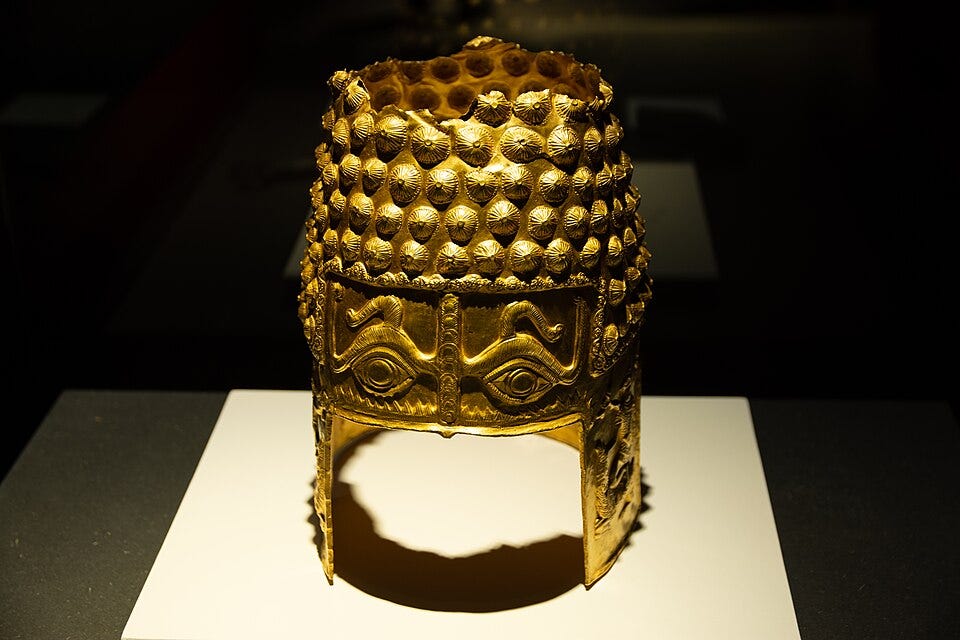

Three men from Heerhugowaard have each been sentenced to 47 months in prison for one of the most striking art thefts in recent Dutch history. The court in Assen ruled on Friday that they were jointly responsible for the theft of a 2,500-year-old golden helmet and three gold bracelets from the Drents Museum in early 2025. Although the case is exceptional, the police say it offers a window onto a wider, much quieter, world of Dutch art crime, dominated by garden statues taken for scrap and a thriving trade in forgeries.
SPONSORED
You’re overpaying your accountant. And they still don’t call you back.

Neno gives you a dedicated bookkeeper, automated admin, real-time financial insights and a free business bank account. Everything your business needs, in one place.
No chasing. No surprises. No unnecessary costs.
The heist
The robbery took place in the early hours of 25 January 2025. The thieves blew open an entrance to the Drents Museum with a heavy explosive and made off with Romanian heritage objects worth around €6 million. The highlight was the almost pure-gold helmet of Coțofenești, dating from the fifth century BC and considered a national symbol in Romania. Three gold bracelets from a Dacian royal collection were taken as well. The pieces had been on loan from the National History Museum of Romania for an exhibition that had never before been shown internationally on this scale.
The helmet and two of the three bracelets have since been recovered; one bracelet is still missing. The helmet was unveiled, under armed guard, at the Drents Museum in April 2026, more than a year after the theft.
Deal, denial and one same sentence
Two of the three convicted men, Chesley W. (37) and Jan B. (21), struck a deal with the prosecutor: in exchange for information and the return of most of the loot, they were promised a lower sentence than usual. The third, Bernhard Z. (36), denied being inside the museum, saying he had only arranged the vehicles and number plates. The court rejected his version, pointing to DNA evidence on sledgehammers, in clothing and in a sports bag, as well as statements made by Jan B. to undercover officers.
All three received the same prison sentence: 47 months. Bernhard Z., who had faced an initial demand of 66 months and no deal, ultimately received the same punishment as the two who cooperated. The court accepted the deal in principle but added three months to the agreed sentences for the two cooperating defendants. As the court put it in its judgment, the importance and value of objects such as the Coțofenești helmet “cannot be expressed in money. They are, in the literal sense, of inestimable value.”
Amateur thieves, not seasoned art criminals
The Drents Museum case fits a wider pattern within Dutch art robberies, the police say: spectacular heists carried out by people with little knowledge of the art world. Erik Venema of the police’s Art and Antiques Crime Team recalls the 2012 theft from the Kunsthal in Rotterdam, where Romanian opportunists made off with seven works by Picasso, Matisse and Gauguin. “In such cases, you have small-time crooks who know nothing about the art world. They take the pieces with great fuss but do not really know what to do with them. Then they panic because all the alarm bells start ringing,” he said. The Kunsthal paintings were most likely burned to erase traces; the Coțofenești helmet, by contrast, was reportedly buried somewhere before being recovered.
In the Drents Museum case too, the thieves left such a large trail of evidence that investigators were able to track them down relatively quickly.
A “solution-oriented” approach
Returning the loot in the Drents Museum case did lead to a lower sentence than originally demanded. That fits a broader Dutch approach to art crime, which Venema describes as “solution-oriented”: getting a stolen work back to its rightful owner often takes priority over the heaviest possible sentence. Police often work with private detectives, who can act as a bridge between criminals and the authorities.
That logic also explains why stolen art often resurfaces as a bargaining chip. A Van Gogh stolen from the Singer Museum in Laren in 2020 was eventually handed back, and Dutch-Italian mafia boss Raffaele Imperiale returned two Van Goghs (stolen from Amsterdam in 2002) in exchange for a reduced sentence in an Italian drugs case in 2016. Criminal groups also sometimes steal high-value works hoping that the insurer will pay part of the work’s value in exchange for its return, a practice known as “art-napping.”
The quieter side of Dutch art crime
For all the attention spectacular cases attract, most Dutch art crime is much smaller and more local. Last year, the police recorded 250 reports of stolen paintings and drawings, and 238 thefts of bronze and copper sculptures, often taken from gardens or even cemeteries, sometimes only for the value of the metal. The police also see a separate, more international trade in cultural heritage and religious objects, with criminals illegally digging up archaeological finds in places such as Syria and Ukraine and trying to sell them on.
The most common form of art crime, however, is forgery. Lithographs, prints and etchings are widely copied and then sold through online platforms such as Catawiki and Marktplaats. One ongoing investigation involves more than 100 fake paintings whose real value is zero, but whose potential sale price runs to more than a million euros. Appraiser Peter van Beveren, who works with the police, told NOS that the amounts involved in art forgery are comparable to those in human or arms trafficking, and that he believes the great majority of art offered for sale online is fake.
For the Drents Museum, Friday’s verdict draws a line under one of the most spectacular cases in years. For the police’s small art team, the daily work, of forgeries, garden statues and the occasional bargained-back masterpiece, continues much as before.