


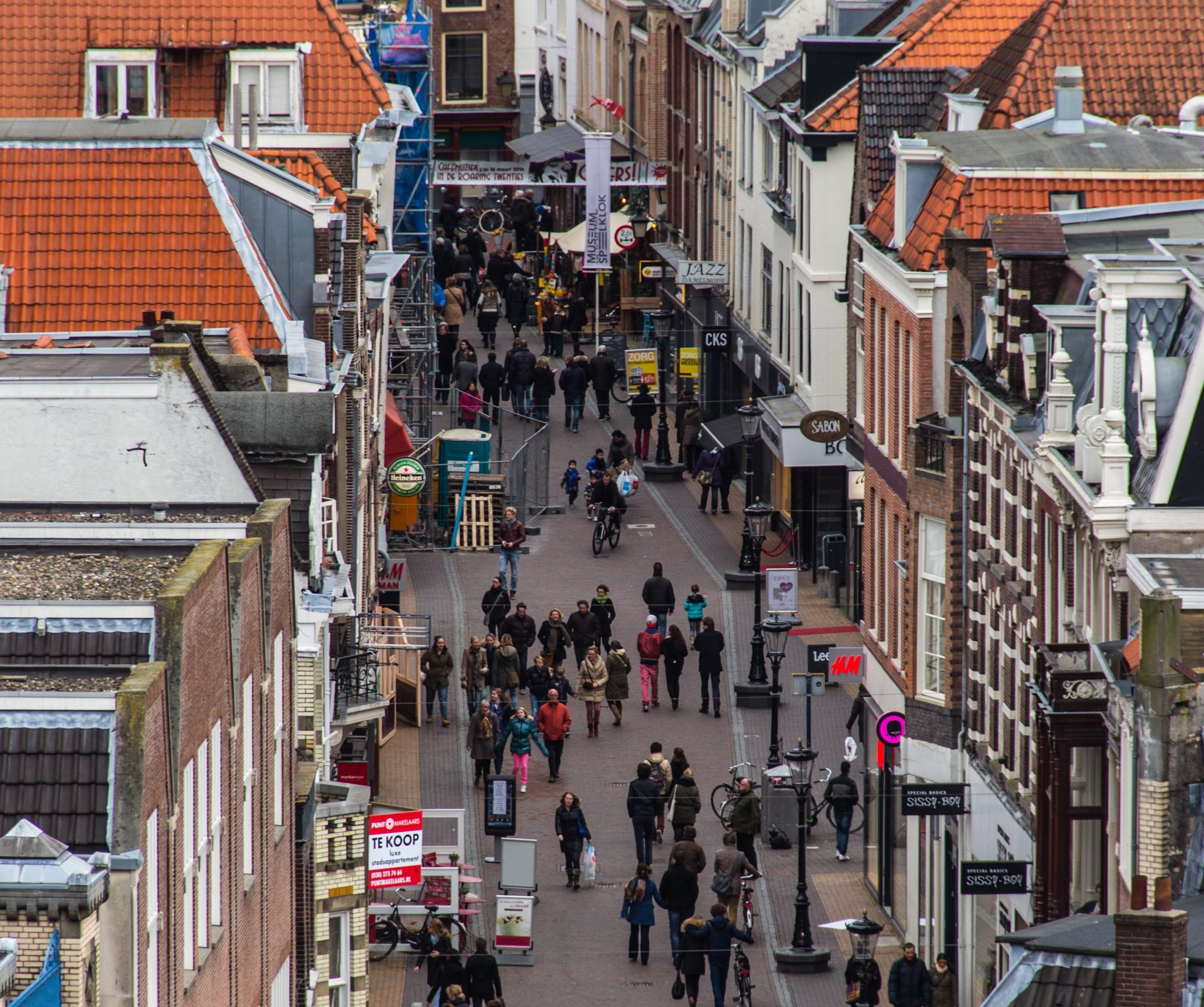
Thousands of people marched through Utrecht on Thursday evening in a solidarity protest against the wave of violence that has surrounded Dutch asylum reception centres in recent weeks. The demonstration came as the cabinet and the country’s municipalities agreed on new steps to deal with the unrest, and as the intelligence service investigates whether the violent protests are being organised.
Rentals in the Netherlands

Signaal tracks the Dutch rental market and notifies you the moment something matches your search. Be first to apply.
The march in Utrecht
The protest began at 6:30 pm on the Domplein in the centre of Utrecht and moved roughly 1.8 kilometres through the city, past the Janskerkhof and the Neude, ending on the Jaarbeursplein. By the time the crowd reached the square, an ANP reporter estimated that thousands of people were taking part.
The march was organised by a collective of 122 organisations, including Amnesty International, Oxfam Novib, Extinction Rebellion, the Dolle Mina’s and Het Actiefonds. Their stated aim was to offer “a positive counterweight to the extreme-right violence at asylum seekers’ centres of the past few weeks,” and their central message was that refugees are welcome.
Among the speakers was Amjad Almatini, himself a refugee. “After seven years in the Netherlands, I still have to prove that I am a human being,” he told the crowd. “We are not a threat, we are people. No one leaves their life, friends and country behind for nothing. People talk about us as a problem, not as people.” Journalist and podcast maker Zoë Papaikonomou also addressed the demonstration, calling on the media to choose their words more carefully and to describe violent anti-asylum demonstrators not as “concerned citizens” but as “xenophobic people.”
Weeks of violence
The solidarity march followed a turbulent few weeks. Protests against the arrival of asylum reception centres turned violent in several towns, including Loosdrecht, IJsselstein, ‘s-Hertogenbosch and Apeldoorn. In Loosdrecht, three days of rioting at the end of April culminated in an arson attempt at the former town hall. In IJsselstein, demonstrators damaged the town hall and the neighbouring Fulcotheater. In Den Bosch, an explosion went off at a building the municipality wanted to use for asylum seekers, and in Apeldoorn, days of protests saw fireworks thrown at police and dozens of arrests.
An AIVD investigation
A key question is who is behind the violence. Asylum and migration minister Bart van den Brink (CDA) has confirmed that the intelligence service AIVD is investigating whether there is organised coordination behind the protests, including the possible involvement of action groups and online networks. One group that appears to play a role is “Defend Netherlands,” which puts out calls for demonstrations on social media.
An analysis by the NOS of arrests at local anti-asylum protests found that a significant share of those detained came from other municipalities, rather than being local residents. Mayors in towns such as Loosdrecht and Uden say part of the crowd deliberately travels in to make the situation escalate.
What the government has agreed
After the riots, the Association of Dutch Municipalities (VNG) demanded urgent talks with the cabinet, warning of “forms of terror and intimidation” and saying that municipalities and police were reaching their limits. Those emergency talks have now produced concrete agreements.
The cabinet and municipalities agreed to work together more closely on carrying out the spreidingswet, the law that obliges municipalities to take in their share of asylum seekers, while acting firmly against violence. The cabinet promised to act in a “norm-setting” way and to enforce the law against rioters. There will also be more tailored arrangements for individual municipalities, and a new “flying team” to help local authorities with the practical problems of housing asylum seekers. VNG chair Sharon Dijksma said afterwards that “the cabinet has taken a step forward tonight, and I am very glad about that.”
A political fault line
The violence has also sharpened political divisions. PVV leader Geert Wilders has called for the spreidingswet to be scrapped altogether and urged municipalities to resist it, while condemning the violence. JA21 has argued that the law confronts residents “from one day to the next” with something they do not want. Van den Brink has responded that he is simply carrying out a law passed by a parliamentary majority, and that those who object should use democratic means. Partij voor de Dieren MP Christine Teunissen, meanwhile, has argued that the country should “have a debate about extreme-right violence” rather than only about asylum.
For now, the AIVD investigation continues, the flying team is being set up, and Van den Brink has said he intends to visit one or more of the affected towns in person. Thursday’s march in Utrecht was, for the organisers, a way of making clear that the loud and sometimes violent protests are not the only voice in the country.