


See more of Dutch Brief in your Google search results
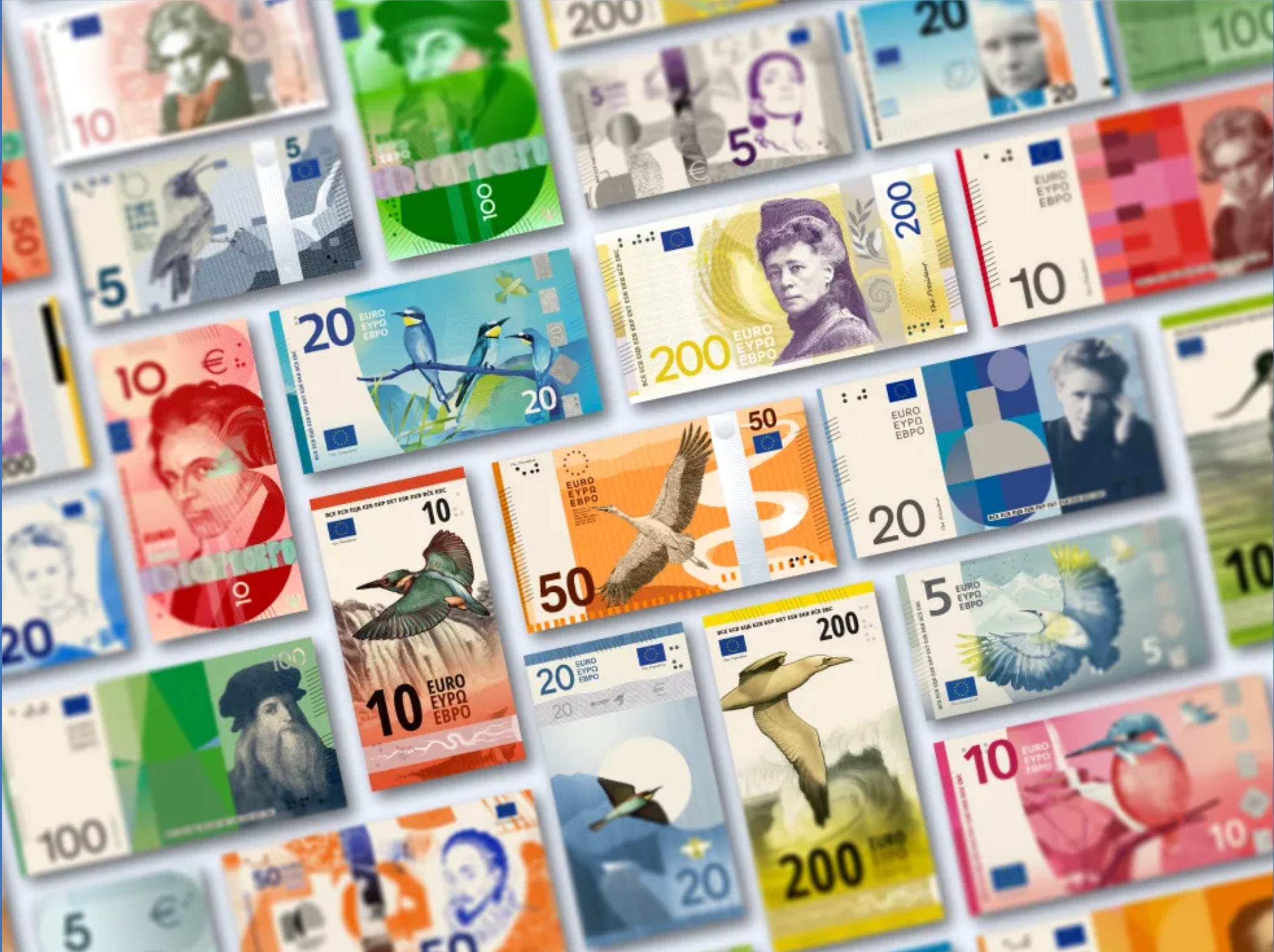
The euro notes in your wallet are due a complete makeover, and for once the public gets a say in how they will look. The European Central Bank has published ten shortlisted designs for the next series of banknotes and opened an online survey in which anyone in Europe can give their opinion.
Two themes, ten designs
The proposals are built around two themes chosen earlier by the ECB: “European culture” and “Rivers and birds”. Five designs have been shortlisted for each. Some are drawn in a more illustrative style, others look more realistic. Some are vertical rather than horizontal, as people are used to.
Famous Europeans
The culture designs feature Europeans who made significant contributions to the continent over past centuries. In order of denomination, they are the Greek-American opera singer Maria Callas on the 5 euro note, the German composer Ludwig van Beethoven on the 10, the Polish-French scientist Marie Curie on the 20, the Spanish writer Miguel de Cervantes on the 50, the Italian artist and inventor Leonardo da Vinci on the 100 and the Austro-Hungarian peace campaigner Bertha von Suttner on the 200. The reverse sides show things connected to their work, such as a school behind Marie Curie and a choir behind Beethoven.
Birds and rivers
The other theme turns to nature. The kingfisher appears on the 10 euro note, the bee-eater on the 20, the white stork on the 50, the avocet on the 100 and the northern gannet on the 200, set against rivers, marshes and coastlines. On the back of these notes are European institutions, including the European Parliament, the European Commission and the European Council. According to the ECB, rivers and birds recognise no borders, which makes them a symbol of freedom and of the connection between Europeans and nature.
A Dutch hand in the designs
There is a Dutch element to the shortlist. Three of the ten proposals were made by Studio Joost Grootens, based in Amsterdam. The accompanying text describes one of the designs as a reflection on how culture comes about.
SPONSORED
You’re overpaying your accountant. And they still don’t call you back.

Neno gives you a dedicated bookkeeper, automated admin, real-time financial insights and a free business bank account. Everything your business needs, in one place.
No chasing. No surprises. No unnecessary costs.
Why the notes are changing
The redesign is not only about looks. By refreshing the series, the ECB is trying to stay ahead of counterfeiters, and the new notes will carry new and improved security features. It will be the first complete redesign since euro notes entered circulation in 2002. The original series showed bridges and parts of buildings, such as gates and windows; the notes were given a facelift from 2013, but this time the designs are entirely new.
There will be no new 500 euro note. That denomination was discontinued in 2019, because it was used mainly by criminals. Existing notes will keep their value.
How the shortlist was chosen
The ten proposals came out of an EU-wide design contest launched last year, which attracted more than 1,200 applications from graphic designers. Twenty-five of them were invited to develop full proposals, and an independent jury of 21 experts, each nominated by a euro area national central bank and drawn from fields including graphic design, communication, history and neuroscience, narrowed the entries down to ten.
“Euro banknotes are more than a means of payment; they are one of the most tangible expressions of Europe,” said ECB president Christine Lagarde, presenting the shortlist.
How to take part
The survey is open to everyone in Europe until 21 September, on the ECB’s website. A parallel survey with the same questions is being carried out among a representative sample of euro area citizens by an independent research company. De Nederlandsche Bank, the Dutch central bank, is encouraging people here to take part.
It is worth being clear about what the vote does. The most popular design will not automatically go into production. The ECB has the final word, and describes the public’s feedback as a key element, but not the only one. The jury’s conclusions and a technical assessment, covering things like production, accessibility and security, will also count. The final design may still be adjusted.
The ECB’s Governing Council is expected to decide around the end of this year. The new notes will then follow in the years after that, though exactly when is not yet known. The euro is the shared currency of around 358 million people in 21 EU countries.