


See more of Dutch Brief in your Google search results
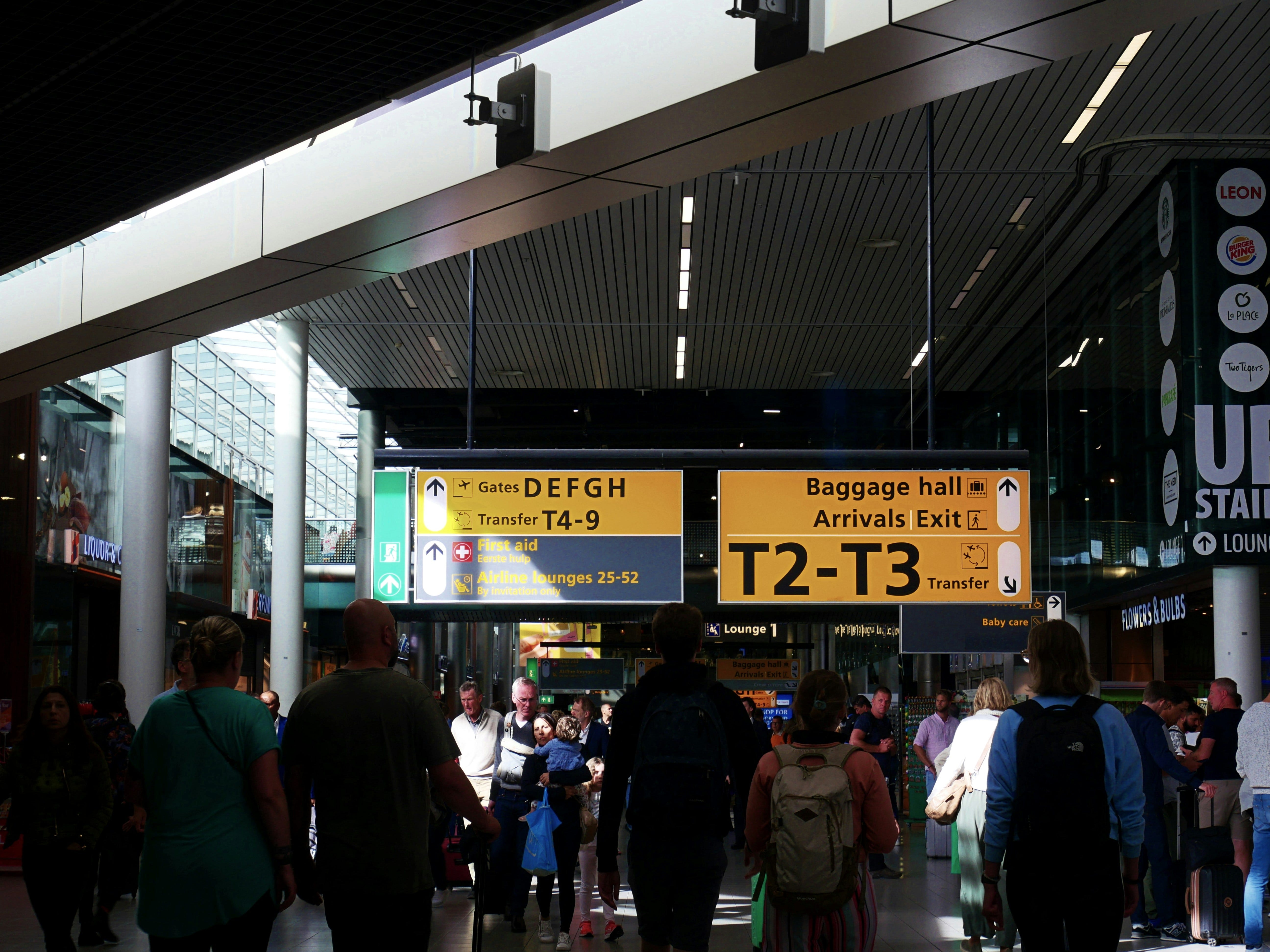
Europe’s airports and airlines have called on the European Union to suspend its new digital border system over the busy summer months, warning that long queues at passport control are causing serious disruption. The appeal comes as travellers, including at Amsterdam’s Schiphol Airport, face growing delays.
What the industry is asking for
In an open letter to European Commission President Ursula von der Leyen, three industry groups said the roll-out of the Entry/Exit System (EES) had reached a “critical point.” The letter was signed by ACI Europe, which represents more than 600 airports, and by the airline associations Airlines for Europe (A4E) and the International Air Transport Association (IATA).
The groups said that since the system was fully introduced in April, waiting times at border control have risen sharply, reaching up to five hours during the busiest periods. They warned that this is disrupting millions of passengers, including families with young children, elderly travellers and people with reduced mobility, and that it is “undermining Europe’s reputation.” Around 40 million more passengers are expected to pass through EU airports in July and August than in the previous two months.
Rather than scrapping the system, the groups want the flexibility to switch it off when needed. They asked the Commission to let member states completely suspend EES checks in July and August whenever passenger numbers exceed what border facilities can handle, reverting to traditional passport checks. They also called for a permanent mechanism, from September, to pause the system when necessary, along with better staffing, more reliable IT and an EU-wide app that would let travellers register in advance.
SPONSORED
You’re overpaying your accountant. And they still don’t call you back.

Neno gives you a dedicated bookkeeper, automated admin, real-time financial insights and a free business bank account. Everything your business needs, in one place.
No chasing. No surprises. No unnecessary costs.
What the EES is
The Entry/Exit System is a digital border system that has applied across the 29 countries of the Schengen area since it was fully rolled out on 10 April 2026, after a phased start the previous October. It replaces the stamping of passports for non-EU travellers on short stays. Instead, when they first enter the area, their passport details are logged along with biometric data, meaning fingerprints and a photograph of their face. People with an EU, Icelandic, Norwegian, Swiss or Liechtenstein passport are not affected.
The situation at Schiphol
Schiphol, one of Europe’s busiest hubs, has felt the strain. In recent weeks, waiting times at passport control rose to two to three hours at some peak moments, leading to delays and causing some travellers to miss their flights. According to the Dutch aviation association BARIN, thousands of passengers have been affected.
In response, the Ministry of Justice and Security announced measures to limit queues this summer. At times of extreme crowding or when the EES has technical problems, the Koninklijke Marechaussee (the military police who run Dutch border control) can temporarily skip the biometric checks and register only passport details, using a fallback procedure for which it says it has the legal authority. The Marechaussee noted that extra staff cannot solve technical failures in the EES system itself.
To keep passengers moving, Schiphol has so far chosen not to record fingerprints and facial scans in every case, registering the passport in the system but phasing in the biometric part gradually. The airport has installed self-service kiosks, added extra staff and adjusted signposting to separate EU and non-EU travellers. The Dutch government is pushing to extend the deadline for fully phasing in the system, currently set at 1 September, a request Schiphol supports.
The Commission pushes back
The European Commission has taken a different view. It maintains that the EES is fully operational and working well, and has said that long waits are most often caused not by the system itself but by pre-existing factors, such as many flights being scheduled in the same time slots. It has pointed out that a first-time registration takes, on average, just over a minute, and has urged airports to ensure enough staff, kiosks and electronic gates, and to promote the pre-registration app.
The travel body WTTC, meanwhile, warned that if three-hour waits become common, around a third of travellers say they would be less likely to visit, which it estimated could put millions of arrivals and billions of euros in spending at risk.
What it means for travellers
For non-EU passport holders flying through Schiphol, the practical advice is to allow plenty of time, with the airport recommending arriving three hours before intercontinental flights. Travellers with an EU passport are not affected by the EES and can use the e-gates if they are over 14. Whether the checks are eased this summer now depends on how the Commission responds to the industry’s request.